Every flooring decision you make affects more than aesthetics. The surface underfoot influences user safety, accessibility compliance, maintenance budgets and the long-term durability of your investment. Whether you’re outfitting a school gymnasium, designing an inclusive playground or renovating a museum gallery, the right commercial floor surfacing can reduce liability risks, lower operational costs and enhance the user experience for years to come.
This guide breaks down the critical factors that shape flooring performance across different environments. You’ll learn how to evaluate durability standards, interpret safety ratings and match surfacing solutions to the specific demands of your facility type. These fundamentals will position you to make a confident, cost-effective decision that serves your community and bottom line.
Think of this section as your buyer’s checklist. Understanding these three factors is the first step to making a smart investment, before you even begin looking at specific materials.
The ideal floor surface depends on your facility’s specific demands. Engineers design commercial-grade flooring with a thicker wear layer and a top surface designed to withstand abrasion, impact and environmental stress. Consider these factors to properly assess whether a surface will meet your facility’s needs.
Up-front cost is only part of the equation. Total cost of ownership includes the labor, materials and downtime required to maintain the surface over its expected lifespan. The following factors should shape your total cost analysis.
Flooring affects user comfort and the experience within a space. Supportive surfaces can accommodate movement patterns during athletic activity. Acoustic properties influence noise levels from footsteps, equipment and group activities.
Rubber flooring also has sound-dampening properties, making it an excellent fit for weight rooms and training areas.
Each facility type presents unique challenges that require specific surfacing solutions. The recommendations below align with the evaluation factors above for real-world applications.
Fitness centers demand flooring that can handle diverse, high-intensity use across multiple zones. Free-weight areas experience frequent drops and heavy impact. Cardio zones require slip resistance to minimize sweat. Sport flooring rolls offer the ideal flooring for indoor gyms, combining durability with efficient installation and cost-effectiveness.
Structure and flexibility are two must-have qualities for movement studio surfaces. Too much rigidity can stress joints during repetitive movements, while too much give can compromise balance. Beyond structural support, the surface should provide reliable traction without being abrasive, allowing for barefoot work and controlled movement. Tiles or flooring rolls are the best flooring options for dance, yoga and Pilates studios, delivering adequate performance with straightforward maintenance.
Gymnastics facilities need flooring that enables controlled movement, traction and performance during demanding routines. Because athletes perform repetitive, high-impact skills, the surface should provide reliable footing without being overly abrasive. Flooring for gymnastics reduces gaps or tripping hazards, protecting athletes’ skin during floor routines.
Flooring for playgrounds should meet stringent requirements for fall protection and accessibility. Critical fall height ratings indicate the maximum height from which a fall can occur with an acceptable level of impact. ADA-compliant surfacing should provide a continuous, accessible route that accommodates wheelchairs, walkers and strollers.
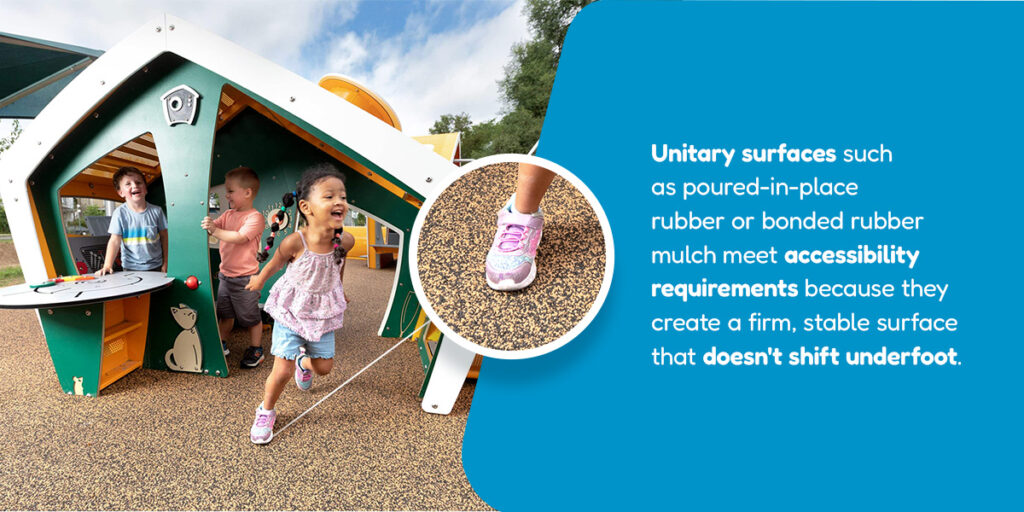
Unitary surfaces such as poured-in-place rubber or bonded rubber mulch meet accessibility requirements because they create a firm, stable surface that doesn’t shift underfoot. Loose-fill materials can meet CFH mandates but settle over time, necessitating maintenance.
Museum flooring balances extreme durability with acoustic and aesthetic requirements. Sound control is paramount — flooring with acoustic-damping properties reduces noise transmission, creating a quieter atmosphere for visitors. Research on museum acoustics demonstrates that finishing materials can influence the auditory environment.
Neutral tones and finishes allow the surface to blend into the background while withstanding heavy foot traffic. Poured-in-place surfacing can serve as a potential solution due to its construction, durability and customizable nature.
Material selection drives performance in commercial applications, with each surface type offering distinct advantages for specific uses.
Poured-in-place rubber surfacing combines rubber granules and binding agents to create a unitary surface that performs across diverse environments over the long term.
Rubber mulch offers two distinct installation methods, each with unique benefits. Loose-fill rubber mulch consists of individual rubber granules spread to a specified depth, providing excellent fall protection at a lower up-front cost than some unitary surfacing options. Bonded rubber mulch uses shredded rubber bound with polyurethane adhesive to create a unitary surface that maintains the natural, textured appearance of mulch while helping reduce displacement issues.
Loose-fill is ideal for projects where the primary goal is maximizing fall protection economically. Bonded rubber mulch is a great solution for clients who want the aesthetic appeal of traditional mulch combined with the ADA-accessible benefits and reduced upkeep of a bonded system.
No Fault Surfaces offers specialized systems engineered for ball response, traction, performance and versatility across a range of indoor sports. Synthetic turf replicates the look and feel of natural grass while reducing maintenance needs associated with natural grass.
Selecting new flooring is a crucial business decision that impacts safety, accessibility, budget and user satisfaction. No Fault Surfaces offers a comprehensive range of surfacing solutions designed to meet the unique demands of every facility type — from playgrounds and parks to fitness centers and museums. With over five decades of industry leadership, 16 million square feet of installation experience and certified crews nationwide, No Fault Surfaces brings the expertise and reliability you need to make confident choices.
Ready to explore the best surfacing solution for your project? Request a quote or contact No Fault Surfaces today to discuss your specific requirements with a knowledgeable specialist.