
Selecting playground surfacing requires balancing budget, safety standards, accessibility, aesthetics and maintenance. Rubber mulch is a durable, shock-absorbing solution chosen by many facility managers and administrators, but the choice between bonded and loose-fill options can significantly impact your project’s success.
Comparing these two surfaces can help you evaluate which option aligns with your project requirements and budget.
Bonded and loose-fill rubber mulch are well-suited for playgrounds. However, understanding their differences can help you decide which will better meet your needs.
Typically made from processed, cleaned and cut recycled tires, loose-fill rubber mulch consists of individual rubber nuggets. These chunks remain independent when spread across the playground, allowing the surface to shift and settle naturally.
Using shredded rubber, bonded rubber mulch then incorporates a polyurethane binder to create a unified, porous surface. This binding process transforms individual pieces into a solid yet permeable layer that remains in place once installed.
Deciding whether bonded or loose rubber mulch is better for your project requires a direct comparison of how each option performs across factors that influence project success.
Bonded and loose rubber mulch provide impact absorption that meets safety requirements, though the depth required varies between options. Effective protection at a critical fall height of 6 feet typically requires 4 inches of loose-fill mulch, while bonded rubber requires 2.75 inches of mulch to offer protection from falls at the same height.
Other safety considerations include the following.
The installation processes differ significantly in complexity and resource requirements. Loose-fill mulch installation requires proper containment systems, such as borders or edging, to prevent material from spreading. Once you’ve established containment, install the mulch by spreading nuggets to the appropriate depth. Many facilities can manage this straightforward process with in-house resources.
Bonded mulch installation requires more extensive preparation, including a prepared sub-base for proper drainage and stability. Mixing the binder correctly may require professional installation by certified crews, who can also ensure the surface cures properly and the finished product meets specifications.
Ongoing maintenance demands vary between the two options, with loose-fill mulch requiring more regular maintenance. This maintenance largely consists of raking to redistribute material and address displacement from active play. However, individual nuggets can also hide debris, and removing it requires more intensive cleaning. Many facilities will also need to add fresh material periodically as the mulch settles or migrates.
In many respects, bonded mulch requires less upkeep than loose-fill mulch. This reduced maintenance burden is due to the unified surface, which prevents displacement and makes debris removal straightforward. Routine inspections and periodic cleaning usually suffice for day-to-day maintenance. However, damage to bonded mulch is more difficult to repair and may require hiring a professional resurfacing crew.
Both surface types are highly durable, regularly lasting a decade or more when well-maintained. But in many cases, bonded rubber mulch lasts longer than loose rubber mulch.
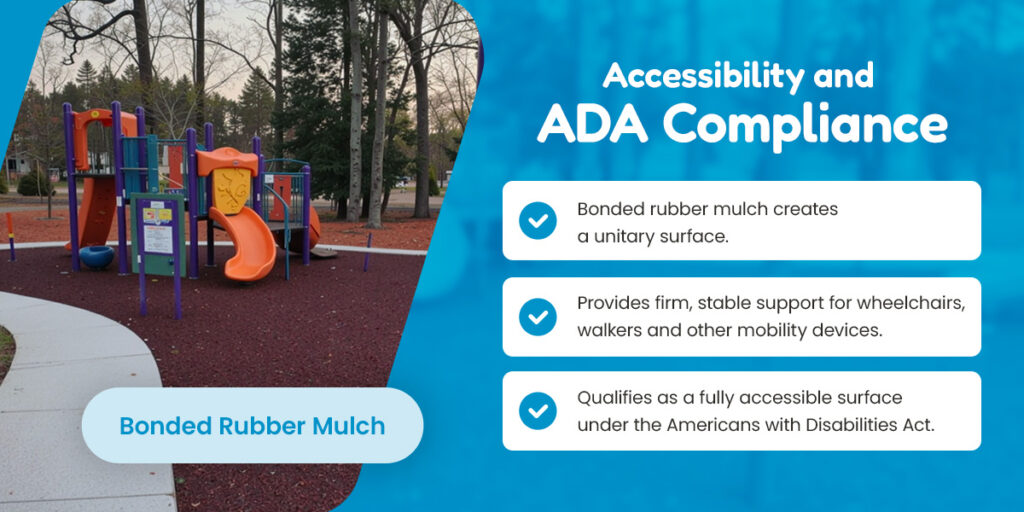
Bonded rubber mulch creates a unitary surface that provides firm, stable support for wheelchairs, walkers and other mobility devices, making it better suited for meeting accessibility requirements. Bonded rubber mulch qualifies as a fully accessible surface under the Americans with Disabilities Act.
While loose-fill rubber mulch can also meet ADA accessibility guidelines, the separate chunks can shift under wheels and create resistance that makes movement difficult for people who use mobility aids.
Both surfacing types offer natural rubber coloring that blends well with outdoor environments. Loose-fill provides a traditional appearance, though creating distinct patterns is challenging since the mulch can become displaced.
Bonded rubber mulch allows for creative design possibilities similar to those found in poured-in-place surfaces, including color patterns, borders and custom configurations. This flexibility allows facilities to incorporate branding elements or aesthetic features.
To compare the cost of bonded rubber mulch and loose-fill mulch, you need to look at the initial and total life cycle costs.
Loose-fill rubber mulch is less expensive up front, making it attractive for budget-conscious projects. However, life cycle costs can be higher due to ongoing needs for top-offs, redistribution and more frequent maintenance labor.
Bonded rubber mulch requires a larger initial investment because it necessitates professional site preparation and installation. However, reduced maintenance expenses, longer service life and lower labor requirements often offset this higher price tag. When evaluating total cost across 10 to 15 years, bonded rubber mulch frequently delivers more predictable and potentially lower life cycle costs.
A direct comparison between the two surface types makes it easier to evaluate which rubber mulch option aligns with your facility’s priorities and resources.
Schools with budget restrictions routinely choose loose-fill playground surfacing. It may be a better choice for projects with these criteria.
Bonded rubber mulch better serves projects with different priorities and considerations.
Public parks and recreational facilities often incorporate bonded rubber mulch where durability, accessibility and reduced maintenance align with goals. Low-maintenance landscaping projects that aim to create a specific aesthetic may also prefer bonded rubber mulch.
Whether you’re leaning toward bonded rubber mulch for its accessibility and durability or loose-fill for its flexibility and lower up-front cost, the right choice ultimately depends on your project’s unique requirements. No Fault Surfaces brings over 50 years of playground surfacing expertise to eliminate the guesswork.
With millions of square feet of surfacing installed worldwide, our certified installation crews deliver consistent results backed by our industry-leading warranty. Ready to explore which rubber mulch solution fits your project? Contact us today for a consultation or quote.