
Organizations planning new playgrounds often build their grant budgets around equipment costs, leaving surfacing as an afterthought. By the time you’re ready to submit your application, surfacing may either get squeezed into a vague category or left out entirely. This planning mistake can lead to significant financial consequences and make your funding bid less competitive.
Playground surfacing funding is available through federal programs, state recycled rubber initiatives, nonprofit grants and corporate giving. With a strategic approach, it’s possible to build surfacing into a grant-ready budget and strengthen your proposal by including it from the start.
This guide can help you fund the playground of your dreams. Discover who can provide financing and where to find it, the most effective ways to approach potential donors and funding rules to follow.
Playground surfacing qualifies for funding across multiple grant categories, from federal infrastructure programs to state recycling initiatives. Understanding which sources fund surfacing will help your organization build more complete and competitive grant applications.
Federal and state programs fund playground projects, including surfacing, as part of infrastructure investment, community development and recreation access initiatives. The Community Development Block Grant program remains the largest and most accessible federal source of financing, providing approximately $3.3 billion annually to public facilities, including parks and playgrounds. Surfacing is an eligible capital expense within those projects.
The Land and Water Conservation Fund offers another federal avenue for playground surfacing funding. LWCF provides matching grants to states and local governments for outdoor recreation projects, including playground development and renovation.
State-specific programs vary widely in scope and availability. For example, New York’s PLAYS program is a $67.5 million competitive grant initiative that supports the design, construction and renovation of public playgrounds. The program guidelines explicitly list surfacing and groundworks as eligible capital expenditures. California’s Proposition 68 grant program also funds park improvements, with surfacing as an eligible expense.
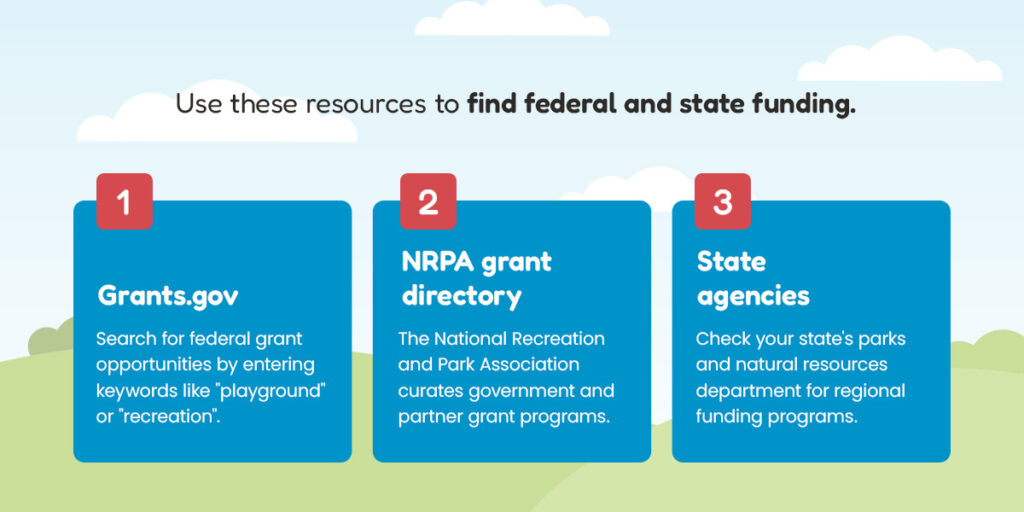
Plenty of similar opportunities exist. Use these resources to find federal and state funding.
State waste tire reduction programs are one of the most direct funding sources for playground surfacing. Many states fund recycled rubber surfacing products through environmental initiatives designed to divert scrap tires from landfills. For example, poured-in-place rubber surfacing (PIP), rubber tiles and bonded rubber mulch can all qualify for these grants.
Kansas’s Department of Health and Environment offers one such initiative, and Missouri’s Department of Natural Resources is another excellent example.
These programs are competitive and state-specific. Check with your state’s department of natural resources or environmental agency to determine whether they operate a scrap tire grant program.
National nonprofits that fund playground projects typically include surfacing as an eligible cost. KaBOOM is one of the most established organizations in this space. Since 1996, the nonprofit has built, opened or improved more than 17,000 playgrounds nationwide. Their community playground grant programs fund equipment, installation and surfacing for qualifying projects. KaBOOM’s Georgia Playspace Refresh Fund awards grants up to $25,000, explicitly covering surfacing repair and replacement.
The National Recreation and Park Association also invests in community playground projects. NRPA invested more than $3.9 million into 136 local communities through grants in 2024. Starting points for identifying nonprofit playground funding include:
Corporate community investment programs fund parks, schools and recreation projects as part of their broader social responsibility initiatives. National corporations such as banks and retail chains maintain community giving programs that award grants for playground improvements. Surfacing qualifies as an eligible expense in many corporate grant structures, particularly when the application emphasizes accessibility or community impact.
Target’s Community Giving program has funded playground projects at schools and community centers. Wells Fargo’s Environmental Solutions for Communities program awards grants for urban green spaces, including playgrounds. The Home Depot Foundation supports community improvement projects with a focus on outdoor spaces where families gather. These programs typically range in value and prioritize communities where the company has a significant employee or customer presence.
Sourcewell offers a different kind of funding advantage. It is not a grant program, but a cooperative purchasing contract that reduces procurement costs. Eligible organizations such as schools, parks, municipalities and nonprofits can purchase surfacing at pre-bid competitive pricing without conducting a separate bidding process. This procurement advantage effectively stretches grant dollars further by reducing the total project cost.
Leaving surfacing out of a grant budget is a planning mistake that weakens applications and creates funding gaps. Many organizations assume surfacing will cost a small fraction of total project expenses, only to discover during vendor quote collection that it represents a substantial — sometimes majority — share of the budget. Including surfacing as a distinct line item from the outset demonstrates financial planning rigor and prevents the common scenario in which a funded equipment grant leaves an organization scrambling to cover unexpected surfacing costs.
Playground surfacing is not a minor add-on. Real project data from Indiana’s Department of Natural Resources shows that surfacing averaged 54% of total project cost across five park projects.
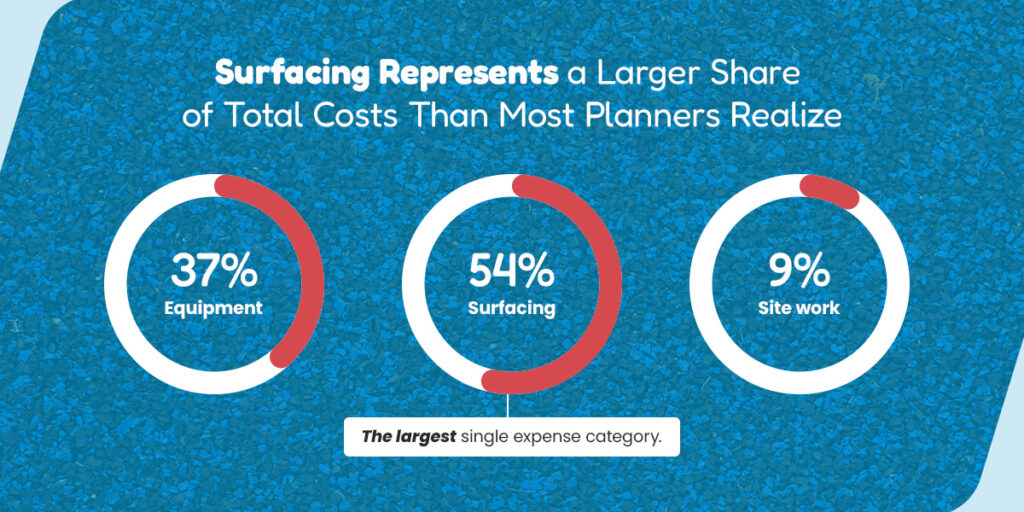
Indiana DNR’s cost formula estimates that poured-in-place surfacing can equal approximately 72% of equipment cost. Industry estimates place surfacing at 20% or more of a typical commercial playground budget. That percentage rises significantly for larger installations or projects emphasizing accessibility. Grant reviewers evaluating the total cost of ownership for playground surfacing will likely recognize this distinction. Applicants who specify a unitary surface and explain the long-term maintenance advantage can therefore build a stronger case.
Granting agencies want evidence of a thoughtful, proactive plan for maintenance and stewardship. Including surfacing in the application signals that the applicant has thought beyond installation day.
Reviewers evaluating what granting agencies look for in playground funding applications prioritize proposals that demonstrate long-range planning. Specifying a unitary surface like PIP or bonded rubber mulch strengthens the application.
Organizations that include a surfacing plan — specifying material type, compliance with critical fall height requirements and maintenance expectations — position themselves as responsible stewards of public funds.
Many grant applications require applicants to specify which surfacing material they plan to use and provide vendor quotes before submission. You can make a more informed decision by understanding the differences between unitary and loose-fill surfacing.
Unitary surfaces — PIP, bonded rubber mulch, rubber tiles:
Benefits of loose-fill surfaces — loose rubber mulch, engineered wood fiber:
Since either surfacing type can meet safety requirements when properly installed and maintained, the choice often depends on budget constraints, accessibility goals and your organization’s capacity for ongoing upkeep.
Applicants planning inclusive playgrounds should prioritize unitary surfaces. Options vary in their ability to support mobility devices and meet accessibility standards, and grant reviewers evaluating accessibility proposals expect to see surfacing choices that align with inclusive design principles. Organizations should review cost comparisons to understand how material choice affects budget and accessibility goals.
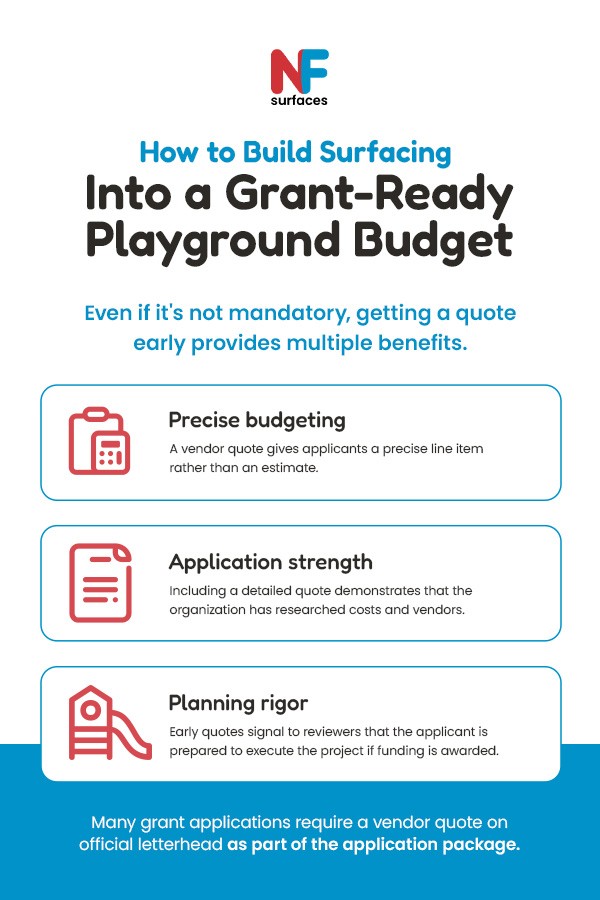
Many grant applications require a vendor quote on official letterhead as part of the application package. Research the criteria for your chosen grant to determine whether you need to procure a quote before applying.
Even if it’s not mandatory, getting a quote early provides multiple benefits.
Organizations that are eligible for Sourcewell cooperative purchasing contracts can simplify procurement requirements by purchasing at pre-bid pricing without conducting a separate bidding process.
Including surfacing in a grant budget is the baseline. Framing it strategically will make your proposal more competitive.
According to data from the National Recreation and Park Association, 86% of U.S. adults believe it is valuable for local government to invest in helping children access inclusive playgrounds.
Specifying industry-specific details, such as ASTM-compliant surfacing and noting critical fall height ratings, signals to reviewers that you will meet regulatory expectations. The CPSC’s Public Playground Safety Handbook provides surfacing guidelines that many state grant programs reference directly. For example, the Kansas Department of Health and Environment’s grant application specifically recommends that applicants follow CPSC Publication 325.
Critical fall height is the highest point from which someone can fall without incurring a life-threatening head injury. Specifying CFH-rated surfacing demonstrates planning rigor. Your organization can also strengthen your proposal by referencing ASTM-compliant playground safety surfacing and explaining how the chosen material meets regulatory expectations. Review tips for writing a winning playground grant proposal to learn how to frame these details effectively.
For decades, No Fault Surfaces has delivered playground surfacing solutions for schools, parks, churches, municipalities and community organizations. Our company has installed over 16 million square feet of PIP rubber surfacing worldwide, with certified installation crews that achieve consistent quality and compliance with ASTM standards.
Whether your project calls for PIP playground safety surfacing, bonded rubber mulch, loose-fill rubber mulch or rubber safety tiles, our team can provide the vendor quote your grant application requires.
Ready to submit a watertight funding application for your playground surfacing? Reach out to our team for advice or request a quote today.